
“I’m a duck on a pond, just here having a good time.”
That’s how Durham, NC guitarist and songwriter Spencer Thomas Smith describes himself to me with a smile, as we share our morning coffees over Zoom, with a fresh inch of snow outside. The weather had interrupted our plans to meet in person, but I was just happy to find the time to chat music with him.
It’s a great descriptor, I couldn’t find a better way to describe Smith’s easy, comfortable demeanor, both on record and in conversation. It’s one the certainly likes, as he literally had it tattooed on his thigh: a vignette of a duck in the water with reeds around it, done in the American traditional style. It’s a reminder of the mantra he came up with for 2025 – something he tries to create for himself every year – about finding contentment in yourself and your surroundings. It joins an extensive collection of other drawings, symbols, and scenes inked all over Smith’s body, colorful way he’s captured and carried around his life’s memories and mementos.
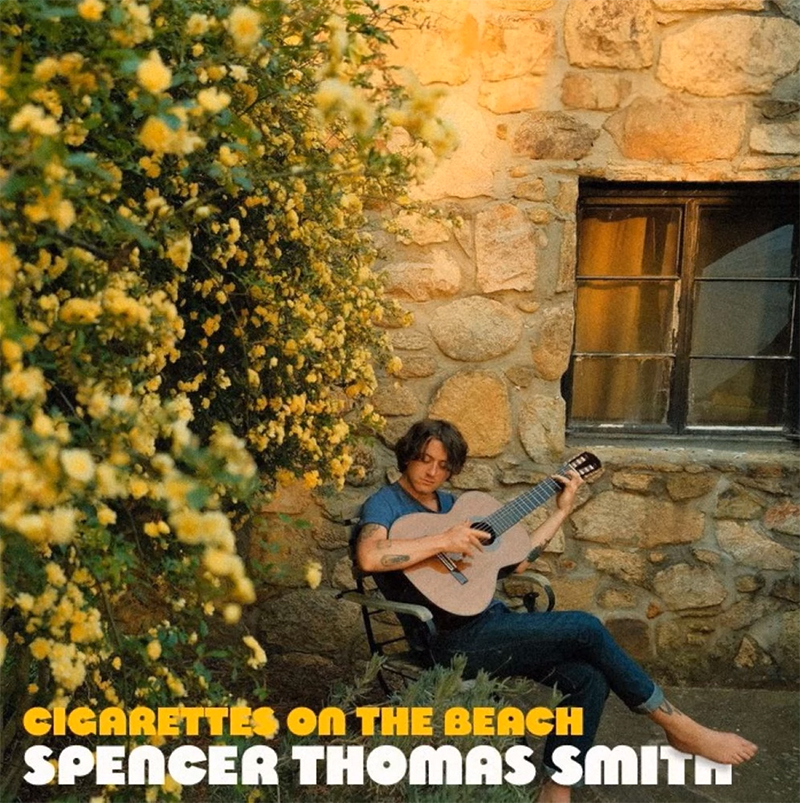
It’s a life this Tennessee-native also captures in his growing catalog of easy comes-easy flows, country-folk reveries. This past fall Smith released his fourth solo album Cigarettes On The Beach, a subtle hummer of an album, filled with going-nowhere country vamps and quiet observations wrapped in poetic, finger-picked melodies. It’s a follow-up to 2023’s Gas Station Blue and continues a blossoming creative period for Smith in his new-ish home of North Carolina, as he meditates on his mantra of contentment, trying to feel and understand the new rhythms reverberating through his life.

Smith was born and raised in Franklin, Tennessee, outside Nashville. He married early, was a faithful Christian youth leader, and spent years navigating the Nashville music scene as a lead guitarist and songwriter. He released a couple albums and EPs in that time, all in a more polished sound that feels like it’s been worked over by different perspectives and production, to the point where the songs have a generic smoothness to them.
As the years progress, however, Smith’s foundations begin to shift and crack in significant ways. Both him and his wife felt a gradual but persistent erosion of their faith, wherein each would eventually find it no longer felt like a resonant worldview. With an isolating move from Nashville to Connecticut during the pandemic – where Smith wrote most of the material that would end up on Gas Station Blue – his marriage felt strained and unmoored from its original convictions. Growing older and removed from his original network and community in the Nashville scene, Smith’s songwriting also began to change, becoming more self-reflective and immediate, more scruff than smooth. By the time he and his wife found themselves in Durham a couple years later, they were again in a new city, no longer practicing the religion their relationship had been born within, and each had matured in different pathways that eventually led to a divorce. It was a gradual, painful, wholesale change, a full shedding of Smith’s former life like the skin of a blue-eyed rattlesnake.
“I got married at 23. I got divorced at 30. I met my wife when I was 18. I have never experienced an adult life as a single person, figuring out actually what I want. There’s been a lot of just figuring that out, which is really cool, I really appreciate it,” said Smith.
That persistent curiosity is something he’s been happy to indulge and develop in Durham. He works quickly and confidently, taking no more than an hour or so writing and arrange most songs, recording onto his phone as soon as it feels good (he has over 70 songs saved as voice memos). If he can’t somehow find a little hook or observation to whittle out, maybe he’ll go for a run, maybe he’ll read quietly in a bar with a baseball game on, maybe he’ll take the dog on a walk. It doesn’t really matter, the songs will come as life comes, so he’s trying to live with an open ear, maybe find something silly to say about sunflower seeds and sunsets.
These recent Carolina albums Gas Station Blues, and especially Cigarettes on the Beach, reflect that outlook. They are definitely an easier hang than his Nashville work, which Smith credits this to friend and producer Bennet Littlejohn of Asheville, North Carolina, who was able to understand the songwriter’s vision in ways he hadn’t experienced in previous recording sessions. The songs feel more loose and off the cuff as a David Rawlings production, like on the warm country tumble “Blue Eyed Rattlesnake,” from Cigarettes on the Beach. Smith also has a knack for wry, tender scenes, similar to John Prine, that are revealing, like quiet standout “Honeydew.” These newer records even showcase a change in the singer’s tonal delivery, shifting from a more straightforward croon to a dynamic one that can swell from soft pillow-talk to a vulnerable howl.
After our conversation, I got the distinct pleasure to slip in and catch the songwriter play a couple songs at Durham creative space Perfect Lovers. He had his guitar, a harmonica, a Modelo, and nowhere to be but there for 30 minutes. The songs billowed with spirit, with Smith painting pretty panoramic ditties on sunburnt screed “Gas Station Blues,” and burning a delicate fire with the wistful “Happy,” while exhibiting a shy charm inbetween songs. There was a deft craftsmanship that you can trace to his formidable years playing in the Nashville scene, with a poetic passion in his style and delivery them from his years in Conneticut and Carolina, that’s easy to admire and draws you in closer to hear more.
By 8 pm, Spencer Thomas Smith had a full day of work, played a couple songs for eager ears, with an open-ended Friday night in his palm. For the moment, he seemed pretty content, just having a good time being there.

This conversation with Spencer Thomas Smith has been edited for length and clarity.
Boogixote: You write stuff quickly. It doesn’t sit too long in your head. it really felt like someone’s kind of dedication to journaling every day, where it’s like, here’s three to eight lines. An Instagram Story you put out said that you got 75 songs recorded on your phone in various stages. What’s it like to document songwriting in a dedicated fashion?
Spencer Thomas Smith: I don’t do morning pages or anything like that. I used to journal a lot. Right after college I just started writing songs, sitting down at my guitar every day, and trying to put something out, and like, being okay with it. Normally writing a song takes me anywhere between 15 minutes and an hour, and then I’m just done with it. I’ll revisit it if I need to tweak something, but the overall bones of it are there. I just record it on voice memo, and then I save it to Dropbox.
In the past year, I’ve been taking bits and pieces of songs that completely didn’t work and taking one thing that I really liked out of it and reworking that into a whole different song. Then, I’m okay with something being really bad. Just like in morning pages, I try to write different things. I’ll sit down and be like, I want to write something like this, just try it, and then I’ll be done with it, I don’t need to do it again.
Boogixote: I went back to some of your earlier stuff. The first one’s felt like they had a finer edge to it, and I feel like the last two albums there’s a little bit more looseness to it. On “Sunflower Seed”, it barely even got to the second chorus before it was just like, visually, it felt like you were ending that song, and the shot would pan out and you’d just be in some fields driving along, onto the next thing.
Smith: Cigarettes On the Beach, all of these songs are kind of related. I used to live in east Tennessee, and I’m driving from 64 or 74 from east Tennessee out here, driving all the way to the coast. It’s just observations and different feelings at different points in time.
“Sunflower Seed” is actually the oldest song that I wrote, like four years ago. I normally don’t revisit songs, but it kept feeling good. I’m really into short, old country songs that don’t say too much. I like that idea of drawing a picture, or like little pictures of each and every thing, it feels more like feelings. Where I find my creative brain works, is pulling out those pictures. On this album, I made it [in a way] for a listener to not see the full picture, which is actually really cool to me.
I listened to an interview with M. C. Taylor of His Golden Messenger about wanting songs to always be alive. I never ask myself what a song means, because I want it to change within me, so I can always revisit it and find something new out of it. For the audience, I never wanna tell the audience what I’m actually singing about. I want them to figure it out. You can find your truth in it.
Boogixote: You write relatively observational type stuff, that’s what I like about it. It’s observational, it’s an extension of what you’re doing. What kind of things are you noticing and is anything feeling interesting to talk about?
Smith: I think especially this last half of this year, I’m just really focusing on contentment. I’ve noticed a lot of the stuff that I’ve been putting out or that’s been working through my brain is, how can I be content in this moment? I wrote a song this week just about my anxiety and how it feels in my body. It was the first time where I was feeling really anxious and I was just observing my body, and put out something that made me feel like, that’s my experience.
Another thing that I really saw in my writing in general is making sure there’s always competing feelings, it’s never just happy, or it’s never just sad, or never just lonely. There always needs to be hope, to feel alive to me.
That song was about anxiety, the feeling in my body, feeling my neck, feeling disassociated. But to end the song, I’m gonna take off all my clothes and just jump in the river. You gotta have both, that’s what makes me feel like that’s a good, complete song in my head. Or if you’re in the middle of a really happy song, there needs to be a hint of loneliness. Learning who I and who I am as a single person.
Boogixote: How do you fit in your friend group and how do you think that informs what comes out in your music?
Smith: I would say I’m a pretty insular person. I’m very introverted. Most of the time I’m just hanging out with me and my dog, going on long walks. That’s something I’ve also been working on since New Year’s, getting a friend group. I go play pool every Thursday with some people down at the Green Room.
I’m also pretty silly. I feel like I have this childlike quality in myself, but also it’s very shy and insular and to myself. I’m a person at the party that sits in the corner, but I’m totally cool being there
Boogixote: I was curious about your tattoo of a duck on the pond, but everything else too, because you got a good collection.
Smith: I have a lot of tattoos. My eagle, my peppers, and my rooster here are all for my different grandparents. For my grandmother on dad’s side, my dad used to decorate her house with roosters; that’s why I got the rooster. My mom’s mom decorated with wooden ducks, art wooden ducks or actual decoys. There’s a nice little mallard back there. When I was working through my emotions of last year, I was just like, I’m just going to try to be a duck on a pond. I’m just going to try to be happy to be here. Some ducks fly south, some don’t. Some fly south with a partner, some don’t. You know, it’s just like, I’m a duck on a pond, just here having a good time.
My other favorite beside my duck right now is this shopping bag. It’s always been my favorite. I had a cousin, he was 23, and he was like 10 years older than me. My favorite memory of him was when he came to my town because he was playing collegiate soccer, and it was Halloween. It was a Friday night and we had to get to the football game, but my cousin took me out trick or treating for like 10 minutes. That was like my favorite memory and the thing that I loved most about him. He was just a cool guy, I wish I would have gotten to know him better.
Boogixote: I was curious about your running. I’ve been picking up running this last year or so, never fast, but it seems like you can put dozens of miles underneath of you. Where’s that coming from?
Smith: I’d done half marathons before. When I hit 30, I was going to run 30 miles on my 30th. So I did it, and I just kept up the miles, and I’ve really enjoyed it, and it’s really meditative for me. I find myself raw-dogging three hours of straight running, just meditation, and it’s been really, really helpful for my life. It gets me outside and I love being outside. On a Sunday, I’m just outside for three hours and that feels really nice to me. Especially, throughout a week when you’re working.
Boogixote: I did the 40-mile relay at Shakori 40 and I know you did too. I don’t have the stamina yet, four miles is still the most I’ll do. That was the first time I ran in like an actual event, I really dug how they incorporated a festival-type atmosphere.
Smith: Race culture is always very interesting. That was an interesting experience because I feel like that’s outside the norm. It’s a relay, you’re just partying the whole time, and sometimes you’re running. But, sometimes you do a 5k or half marathon and you get to the start line, they shoot up the gun, you run. There are some really cool races out there, where during the race, it’s really cool and inviting. But then afterwards, there’s nothing. You know you’re not going to get a medal, you’re just like, I did it. I’m done. I’m going home. And it’s an accomplished thing, which is great, people need goals.
But I was talking to a friend about running culture and biking and climbing culture. We were talking about how running is a nice culture, because all you need is shoes, and you can really run in anything, in terms of shoes. It’s easier to start, it’s easier to find a community or a run club. But also races are expensive. I don’t have the money
Boogixote: Yeah, you are wondering what was the experience that I paid for?
Smith: I have a weird relationship with running because my dad is a big runner, but I have a lot of trauma from my dad. I’m really happy for my dad that he has that community, he has the resources to pay to go do that, and like, that makes him happy and feel like a part of the community. That’s great, but it’s like, that’s not for me.
I posted a song yesterday called “Magic”, about my experience going back to my parent’s church. That song is about me sitting at Christmas Eve service being like, Oh, I get the magician and the audience watching it. I’m really happy that people are enjoying it. That’s really cool. But, I see it, I see the trick. The trick isn’t, God, necessarily. The trick for me in that moment was the emotion.
I grew up very evangelical with shows and stuff like that. To me, that’s magic. People love concerts that make you feel a part of the community and some deeper power to give a shit. But for me, I’m looking at that like, oh, no, I see a thing.
That’s why I love music. Church made me love music because I love the idea of creating emotion. I was a worship leader for a long time until I was like 25, 26. That’s what you do. That’s what you do in a concert, you create a set, that’s what you do on an album, you create something to evoke a feeling in someone. You lay the groundwork to push them there.
So, as a worship leader, you lay the groundwork so the audience or the participants can feel God, or feel the supernatural. I was like, I can’t do that anymore. I’m not in it anymore. I know it’s magic and I don’t have that skill anymore, I don’t have the desire to try and flip that switch.
Boogixote: Before we go, when people start to check out the album or your songs on Instagram, is there anything that you hope people pick up on?
Smith: When it comes to music specifically and being an artist, I just want to make music. We live in a weird world where you’re either making it or you’re not, and I’m here to write songs and put them out, and that’s all I want to do. I just want to play music.
It’s also about connections. What I’ve struggled with the business side of the music industry is it’s just like Wall Street. Nashville’s just Wall Street, whiskey, jeans, and Flintstones. You’re there to make connections and to move to the next step. Which is great for some people, but that’s also so isolating. I want to be open to all types of artists who are just being themselves. The same reason why I like music is because it’s good. I don’t want it to be about connections.
I’ve been thinking about this; it’s all luck that Kris Kristofferson walked into the bar and saw John Prine playing in Chicago. There’s no reason for him to be there. They just happened to have that experience and that’s really cool.
You can’t hope for that. I mean, you can hope for that, that’s great. But you can’t rely on someone famous coming to a show, someone with deeper connections to be like, oh, I like that. No, you just gotta play your songs. I think John Primes was playing his songs because he was a mailman in Chicago and he liked to play music.

 Boogixote